List the shapes you need to store
Long-handled rakes and shovels need vertical support or a compatible rail arrangement. A mower needs a floor position and access for the complete machine, including handles and discharge equipment. Gloves and small accessories can suit a box or cabinet, but sharp heads need controlled access.
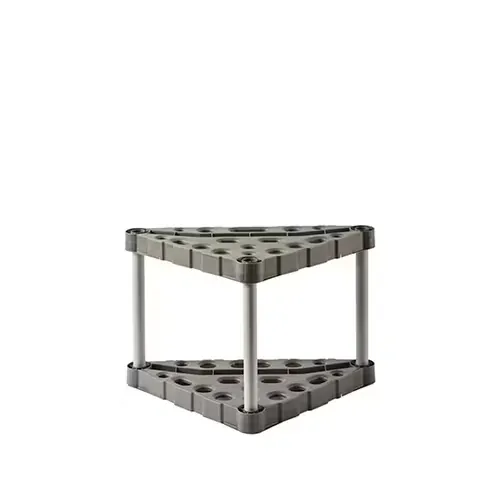
Rubbermaid’s corner tool tower is a rack format with a stated capacity of up to 30 tools. That count depends on the tools and arrangement. It does not mean 30 arbitrary heavy implements will fit or be stable without an appropriate location and any specified anchoring.
Measure the opening, not just the interior
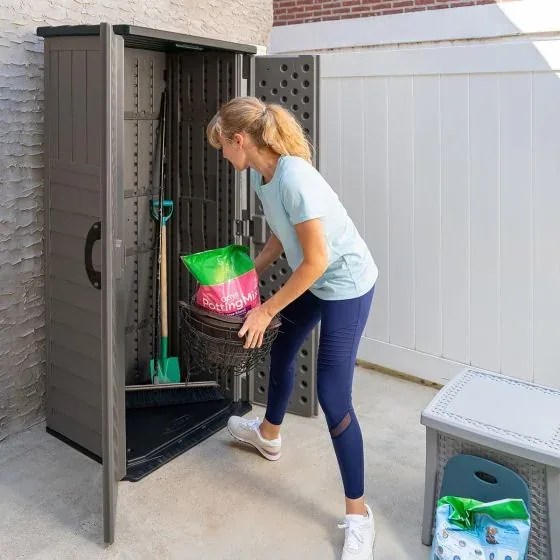
Suncast BMS1250SB’s vertical-shed record lists a 27-inch-wide door opening and an interior about 27 inches wide by 20.25 inches deep. A large advertised volume cannot admit an object that will not pass through that opening. Handle orientation and the movement needed to turn an item inside can reduce usable fit further.
A horizontal shed has a different access pattern. Suncast BMS4720 provides front doors and a top-loading lid with a listed 63-by-46.5-inch door opening. The opening and the available lid clearance should be compared separately from the exterior footprint.
Use interior dimensions for small-equipment boxes
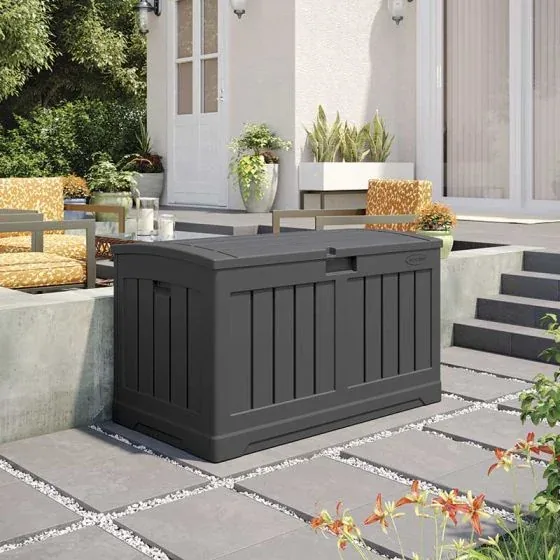
Suncast DB5025P lists interior dimensions of 34.25 by 17.75 by 19.25 inches. Compare those dimensions with the complete stored object, rather than assuming any item described as 50 gallons will fit. A box’s seating or load rating, where supplied, is a separate specification from its internal volume.
Allow space for taking tools out without lifting another sharp or heavy item over them. A storage plan that requires emptying the whole box for the weekly tool can be less useful than a smaller dedicated rack.
Keep storage compatibility separate from weather resistance
A weather-resistant outdoor box is not automatically an approved place to charge or store lithium batteries, fuels, fertilizers or chemicals. Follow the exact product’s storage and ventilation requirements. Do not infer a fire rating or a secure hazardous-material cabinet from resin construction or a lockable lid.
The EGO battery guide can help decide which packs and chargers are needed; its storage instructions still come from the battery and charger manuals. Buying a larger cabinet does not remove those requirements.
Common buying questions
Why can an item fail to fit in a large-capacity shed?
The door opening, turning space and interior shape can be more restrictive than the total volume.
Can any outdoor box be used to charge tool batteries?
No. Use the exact battery, charger and enclosure requirements rather than assuming weather resistance establishes charging suitability.